Thursday, 12 November 2009

Strong Adjectives. Crossword


Well, I'm back as I promised, and not as sleepy as I was last night.

I've just prepared a very attractive crossword about strong adjectives. Lots of new vocabulary. Have a go and see if you know them all. Have a happy weekend.

Wednesday, 11 November 2009

Strong adjectives


When we speak or write we can make a story more dramatic by using strong adjectives (exhausted instead of tired, delighted instead of pleased). We can also make adjectives even stronger by adding an adverb (absolutely, very, really), e.g. The weather was absolutely freezing! (Careful how we use these adverbs!!)
Here's a silly game that will help you to remember some of the most common strong adjectives. Try this link for further practice. How about a pps (powerpoint slideshow) to test how much you have learnt about strong adjectives?
I promise a crossword for the weekend. Too late now. Good night!

Tuesday, 10 November 2009

Remembrance Day. Poppy Day.


Once again, like every year since 1918 Britain celebrates Remembrance Day. The eleventh hour of the eleventh day of the eleventh month marks the signing of the Armistice, on 11th November 1918, to signal the end of World War One. This is what we know as Remembrance Day.
Remembrance Day is celebrated in many other countries whose young soldiers died in World Wars I and II. Read about the celebration in Canada.
You can listen to The Last Post, a bugle call used at Commonwealth military funerals and ceremonies commemorating those who have fallen in war. Many people wrote poetry about their friends fallen in war. Probably one the most famous poems is "In Flanders Fields", by John MacCrae.
Remembrance Day is best known as Poppy Day. Find out here why a poppy and why people wear a poppy on this day.
Watch this video on Remembrance Day in Canada.

Sunday, 8 November 2009

20th anniversary of the fall of the Berlin Wall


Tomorrow, November 9th 2009, it is celebrated the 20th anniversary of the fall of the Berlin Wall. For over a quarter of a century, since 1961, this terribly famous wall, also known as The Iron Curtain, divided Germany -and Europe- in two parts.
The BBC reported the event in this article.
Here's a historical video document of what happened those days when the wall was finally pulled down.


Maybe you would like to have a look at John Kennedy's speech in Berlin during his official visit in 1963, which ended with the famous sentence: "Ich bin ein Berliner".


Last October 31st the leaders of Germany, the United States and the Soviet Union in 1989 gathered in Berlin to take part in the celebration marking the 20th anniversary of the fall of the Berlin Wall which put an end to the European Cold War.

Saturday, 7 November 2009

What for?


People very often confuse the purpose of an action (what for?) with the reason why we do it. If we look carefully we will realize that they are two different concepts. In simple words we could say that the "purpose" looks ahead and generally has to do with ourselves, with our personal intentions or objectives, while the "reason" usually looks back and often has to do with other people's impositions upon us.

Today we are going to study purpose clauses and very soon we'll study the clauses of reason. Here you will find a good explanation on how clauses of purpose work, a set of exercises and a few sentences in Spanish to translate into English. Good luck! Remember the teacher is always around to help you if you need it.
Here's a short poem by horror writer Kristy M. Tallman called "Why & what for..."

Friday, 6 November 2009

Happy Birthday, Charo!


Today is my wife's birthday. With the passing of time her age has become a "national secret", but nevertheless we wish you a very HAPPY BIRTHDAY from our blog, Charo!!!
Every year my mother-in-law proudly repeats the story of how she got up very early that day and prepared a delicious omelette for her husband, who worked in the market, before delivering that beautiful baby who weighed nearly six kilos upon her birth.


Tuesday, 3 November 2009

Money. Crossword.


Earn, win, save, waste, invest, spend, blow your money? It's not quite the same, is it? You'd better learn the difference if you want to handle your own money successfully. Have a go at this crossword: you'll find plenty of adjectives, verbs and nouns related with money.

Monday, 2 November 2009

Have you ever seen the rain?


Many students find it difficult to see the difference between the Past Simple and the Present Perfect. The next few days in class we will focus on the correct use of both tenses, so important in the English language. Here you have a couple of documents that will help you to see the different notions and functions that we can express with these two tenses.
  • We use the Present perfect to talk about life experiences, duration lasting until the present, completion and recent events...
  • We use the Past simple to express isolated actions in the past, duration in the past, past habits and routines...
Listen to CCR Creedence Clearwater Revival singing "Have you ever seen the rain?"


Tuesday, 27 October 2009

Money, Money, Money


The next few days we will be talking about money in class. How exciting! To get in the mood, here's a video clip of unforgettable Liza Minelli singing "Money, money, money" in the film Cabaret. The film won 8 Oscars in 1973, including one to the best actress in the leading role, Liza Minelli. If you want to read a bit more about the film Cabaret click here.
Talking about money: "A mark, a yen, a buck, a pound". What is a buck? Do you know the slang word for a pound? What does the edge inscription read on a one-pound coin? It's very interesting to learn a bit more about the British one pound coin.


Sunday, 25 October 2009

End of Daylight Saving Time


As you know at the end of March we set our clocks forward an hour. This is part of an ambitious programme to save energy called Daylight Saving Time. The last Sunday of October (that is today) our clocks go back one hour for the same reason. The change is usually performed during the night so that this last night has actually been the longest night of the year.
If you want to read more about the origin of this practice, how it works and its effects, here's an interesting and serious article in the Wikipedia.
This issue, however, is quite controversial and of course not everybody is happy with this policy: read an article in The Guardian to see how Scottish farmers feel about it.
I've just found this video calling for action against the change of the time twice a year. Have a look at it. What do you think?

Saturday, 24 October 2009

Hallowe'en 2009


Well, once again, Hallowe'en is just round the corner. Let's have a quick look to a nice presentation to have an idea of the origin of this celebration. Some more ideas can be found in this lesson plan; there's some reading comprehension, vocabulary and idioms that you can work on your own; the rest of the activities are better to be done in class. Visit this website to find extra information about how Hallowe'en is celebrated in England.
Here's the clip "This is Hallowe'en", from Tim Burton's "The Nightmare Before Christmas". Enjoy it.


Hallowe'en has a lot to do with superstition. Are you superstitious? What strange or special habits do you have that you consider superstitious?
For information on the Hallowe'en celebration in our Language School, click here.

Thursday, 22 October 2009

Personality. Crossword


How can people be so different from one another? What features make the character of a person so different from their neighbour's? Probably one of the best way to describe the personality of a person is through the use of adjectives. In this crossword you will find a good sample of adjectives we frequently use to describe people's character. Have a good look at them, at their definitions and make sure you feel comfortable using them to describe people's behaviour. A good practice is to imagine different people you know well and associate them to each one of the adjectives seen here.
If you want to read a bit more about personality traits, here you have an interesting list you can browse with very clear definitions of each one of them. What traits do you identify in yourself, your parents, children or couple?
I have shared the following link from our colleague Cristina's blog; you will find here more personality types with their pronunciation. Thank you, Cris.
You're also very welcome to pay a visit to Cristina's English Place. You'll love it.

Sunday, 18 October 2009

The Family


One of my favourite quotes says: "Friends are God's way of apologizing to us for our families". Don't know what you might think of it but it's certainly a very clever quote.
The next few days in class we're going to talk about the family. If you need to check the vocabulary of the members of the family you can do it here. Move the cursor over the figures and you'll see the spelling and hear the pronunciation.
You are invited to read a little more about family structure and family life in Britain today.

A promise is a promise


So many times in class we have used expressions from Beatles' "Please, Mr Postman". ...deliver the letter, the sooner the better, ...please, Mr Postman, look and see, ...wait a minute, ...I've been waiting a long time,...
I kept telling you I was going to bring you the song one day, but I always forgot. Well, a promise is a promise and today I remembered and I also had the time to look for it. So, here you are! Close your eyes and let The Beatles take you back to the sixties.


Grammar: The Future


There are many ways to express the notion of future in English depending basically on the intention of the speaker, their degree of compromise with the action to be done, and the possibilities of the event to actually take place. That makes the correct use of the future a rather complex task for Spanish learners of English.
Somebody told me once that you could recognize Spanish students of English by how little they use the Present Continuous to refer to future arrangements and compromise -something which natives of English do all the time.
Here you have some complete notes on the use of the future. There's lot of information: don't panic, just use what you need and remember that the teacher will be around if you have any further questions.
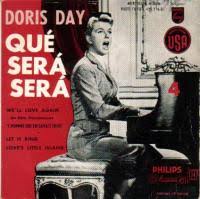
By the way, talking about the future always brings to my memory that beautiful song "Qué será" by Doris Day, part of the soundtrack of Hitchcock's unforgettable thriller "The Man Who Knew Too Much". Lyrics of the song.