Showing posts with label Videos. Show all posts

Sunday, 1 February 2015

Slow down, you move too fast


(Workshop Meetings Feb 2nd and 3rd). Don't you sometimes have the impression that our life seems to be moving too fast and we are always in a hurry? Our modern way of living assumes that faster is better, but many people don't agree with this idea and that is why they have started a movement called "Slow Down". We've probably heard about "slow eating" and also about "slow cities", but you can find much more about this interesting movement in the following link.
The title of this post has been taken from Simon and Garfunkel's song 59th Street Bridge song (feeling groovy)

Wednesday, 5 November 2014

Blogs. How much do we know about them?


Next Monday, Nov 10th, we want to talk about Blogs and share our experience with them and how fond we are of blogs. Check vocabulary and useful questions here.
We have also uploaded a reading text describing why some people started writing their own blogs. 
Blogging has become a very popular activity over the last few years and we believe it is having a dramatic influence on journalism and on what and how people read nowadays. 
As usual, if you wish to read a bit more before the meeting, here are some links:
  • Visit the wikipedia for a definition of blog
  • Want to have a go at creating your own blog? Visit Blogger, a free weblog publishing tool from Google, for sharing text, photos and video.
  • Here's a short YouTube video explaining how to start a blog using Blogger.
  • If you are not yet convinced of starting your own blog, here are 15 reasons why you should do it. 
  • Technicals aspects are usually a drawback. Here are some FAQ related to creating a blog or website. 
And one more week we shall be looking forward to seeing you on next Monday's meeting!! Bye. 

Friday, 31 October 2014

Friendship


For our Nov 3rd Workshop meeting we are going to talk about Friendship. One of my favourite quotes about friendship is this: "Friends are God's way of apologizing to us for our families." What do you think about it? If you wish to read more quotes about friendship here you have a good selection. Have a look at them and see if you have a favourite one or maybe you have a definition of your own for friendship.
See if you can answer some of the questions in this quiz about friends. We'll talk about them in our Monday meeting. Good night.
The Beatles sang a song called "I get by with a little help from my friends." Click here to hear the song with the lyrics.
Come on, don't be shy and post a comment sharing with us how important friends are for you.
PS Oh dear, How could I possibly forget "You've got a friend" by James Taylor?Don't miss it! If any problem with the lyrics, try here.

Wednesday, 15 October 2014

Homelessness


On our Workshop session # 3, on Monday Oct 20th we shall be talking about Homelessness. Here you can download an interesting article published by The Guardian and slightly adapted for school purposes. At the end of the article there are some questions if you want to check your level of reading comprehension (keys are included).
We have also posted a glossary and a series of questions that might help you to participate in our Workshop meeting.
And finally, here you have a few links with extra information related to this week's topic for discussion:
  • Visit the wikipedia for a definition of 'homelessness'.
  • Australian website with plenty of information on homelessness, pictures, statistics... Rebecca's Community is a community group whose staff and volunteers work with people who experience homelessness in Sydney, Australia.
  • Go on and read some real stories behind people who are or were in the street.
  • This famous song, Suzanne, by Leonard Cohen, has always reminded me of a homeless lady.
  • Another day in paradise” (1989) by Phil Collins. Collins sings the song from a third-person perspective, observing as a man crosses the street to ignore a homeless woman, and he implores listeners not to turn a blind eye to homelessness because, by drawing a religious allusion, "it's just another day for you and me in paradise". Collins also appeals directly to God by singing: "Oh lord, is there nothing more anybody can do? Oh lord, there must be something you can say!" 
Enjoy yourself and... see you on Monday!! Don't miss out!
By the way, this week we'll have the visit of Ms Mary Whitefrizz, an English lady who regularly collaborates with Café y Calor, a programme run by Cáritas for homeless people in La Línea. She'll be happy to share her experience with us all and answer our questions.

Sunday, 28 September 2014

Learning a new language: what a challenge!


(Workshop. Sessions # 1 and 2. Oct 6th and 14th 2014)
Here's the content suggested for our first meeting. I thought it might be a good idea to start by sharing our difficulties and achievements in the process of learning English.
Learning to speak a second or third language has become a necessity in our modern world. Everybody agrees on this, but the task proves to be difficult and many people give up somewhere along the way. 
Why is it so difficult for us Spaniards to learn a new language? It is so frustrating to confirm that after  studying a foreign language (usually English) at school for an endless number of years we are still incapable of communicating successfully in that language. Is it something universal or we Spaniards are too dumb to succeed in learning a foreign language? And perhaps the crucial issue, how long does it really take to get to fluency? 
Here are some tips to study a foreign language. Do not desperate if you are not completely happy with your accent speaking English.
Let's share our experience and the frustration or success we've had in learning English. 

Monday, 26 April 2010

She refused to tell me what Mary had told her...


Reported speech means using our own words to report what another person has told us. Reported speech is so important in English first because we use it all the time and second, because it allows us to choose the most appropriate words in order to be as faithful as possible to the original message.
You can find a few grammar tips and exercises here. For further exercises click here.
Here a couple of tutorial videos to illustrate different aspects of the use of Reported Speech. The first one is focussed on the forms, and the second one deals with the use of "say" and "tell" among other things. I think they can be quite useful.


Friday, 16 April 2010

Eyjafjallajökull volcano erupts


The eruption of Eyjafjallajökull volcano in southern Iceland is causing a world crisis due to the cancellation of thousands of flights leaving from or arriving at northern and central Europe.
We want to say a special hello to our schoolmates who were on their way to Ireland on a school trip yesterday and had to come back home straight from the boarding gate of Málaga airport after their flight was cancelled due to the volcanic ash cloud. What a pity!! We are so sorry for you, folks!!

If you want to read further about this event which has collapsed most European airports, take a look at today's Guardian. When you really need to travel in these circumstances, you must be creative to find peculiar -and perhaps expensive- solutions like British comedian John Cleese, who took a $5,100 taxi rice from Oslo to Brussels after becoming stranded in Europe's volcanic ash travel crisis.

I've found this video of the eruption taken from the air.


Wednesday, 7 April 2010

April come she will


It has always been one of my favourite songs by Simon and Garfunkel. I still quite often find myself humming the tune or singing the words. It's hard to describe what I feel when I hear this song, but it's a feeling I like and I long for. So many emotions described in just a few lines. Art Garfunkel said about this song: "I consider it one of the sweetest poems about time." Here are the lyrics:

April, come she will
When streams are ripe and swell with rain;
May, she will stay,
Resting in my arms again.

June, she'll change her tune,
In restless walks she'll prowl the night;
July, she will fly
And give no warning to her flight.

August, die she must,
The autumn winds blow chilly and cold;
September, I'll remember.
A love once new has now grown old.

Now, close your eyes and enjoy the song:


Monday, 5 April 2010

Gerund or infinitive?


To be or not to be? Or shall we better say "to be or being?" One of the most common difficulties for foreign learners of English is when to choose an infinitive or a gerund; and it is not an easy choice indeed. In these notes I have prepared for you you will find lots of information to help you make a correct choice. However the best way is to practise and listen to your inner voice advising you whether to opt for an infinitive or a gerund. If you want to practise a bit more click here.
On the Internet you can find lots of useful materials illustrating the use of gerund vs infinitive. I found this video quite useful and clear. Have a look at it.


Tuesday, 30 March 2010

April Fools' Day


April Fools' Day is celebrated on April 1st. On This day you play hoaxes or other practical jokes on other people to make them look silly or stupid. It's an old tradition of a dubious origin. In the wikipedia you can find a list of some well known pranks which in the last few years appeared on radio, TV, magazines, papers and the Internet; some of them are really curious and funny.
Here is a video with some easy ideas you can use to tease your friends. Which one is your favourite?
By the way don't forget that this year's Easter holidays will last three weeks instead of one!!


A warning to our students visiting the Guinness Storehouse on your next visit to Dublin: have a look at the transformation I suffered after a few pints of Guinness!!

Monday, 22 March 2010

Climbing trees can be a lot of fun


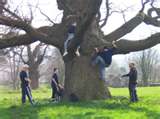
I'm sure we have all climbed a tree some time or other in our childhood. The excitement of being high above the ground, the feeling of the breathtaking view from the top, the risk of the height... But some people have gone much further and have ended up making a hobby, even a sport out of this 'childish activity'. Competitive tree climbing for adults is becoming popular across the world and nowadays there are even tree climbing championships.
The BBC has dedicated a couple of their programmes "6 Minute English" to tree climbing. In session 1 you will learn a lot of new vocabulary about the world of trees. In session 2 you will find out about the tallest and oldest trees in the world and also about what is like to spend the night up on a tree.
Give it a go (I mean to the listening, not the climbing), you'll enjoy yourself very much. (Remember you can download the transcripts if you have any difficulties understanding the recordings).

Saturday, 20 March 2010

Spring is here again


Spring is just round the corner... when does spring officially start this year?
One of the annual consequences of the arrival of spring is the changing of time, the so called Summer Daylight Saving. Every year, the last Sunday in March we set our clocks one hour forward, remember: "Spring forward, fall back." So in spring, an hour forward, in autumn or fall we go an hour back. Pay a visit to this pretty website to find more information.
Listen to this podcast explaining the origins of the tradition. Is everybody happy with this decision? What did the Romans use to do way back in the old times? Here you can read the transcript of the recording if you have any doubts.
After listening to the podcast watch this BBC video about the possibility of having BST (British Summer Time) all year round, is it a popular idea?
Why not share with us what spring means to you?

Tuesday, 16 March 2010

Saint Patrick's Day


On March 17th Irish people all over the world celebrate St Patrick's Day (Patron Saint of Ireland). Here you can find information about St Patrick's Day 2010.
Our dear friend Ana, from Estepona, has sent us a PPS with plenty of interesting things about this special day. Enjoy it.
And of course a video, this time recommended by our colleague Tim, a true Irishman. Hard to follow? Have a look at the lyrics here. Don't forget to pay a visit to Tim's blog where you'll find the "real Irish thing". (Thanks Tim. Happy St Patrick's Day! We'll miss last year's concert!)


Saturday, 6 March 2010

International Women's Day 2010


International Women's Day is celebrated on March 8th. Visit the official website for this annual event and read about the programme for this year 2010.
This link will take you to the Message from Irina Bokova, Director-General of UNESCO on the occasion of International Women's Day.
In the video below you will find some impressive facts about the importance of women's role in the world today.
What do you think about this celebration? Post a comment with your opinion. What does WFP stand for? Do you know about their activities?


Monday, 22 February 2010

Practise your English with lyrics


I've just learnt about a new website Lyricstraining.com where you can practise your English using song lyrics. It's interactive and quite amusing. You can choose the level of difficulty too. Have a go at it, I'm sure you'll enjoy it. Make sure you read the instructions (help) before you use it. Choose your level and go. Click here to try an example.

Sunday, 21 February 2010

No, no regrets


To express regret means to feel sorry or repentant about something you have done that you wish you had not done or you shouldn't have done or about something you haven't done that you now feel you should/could have done. I guess we all have things we regret if we look back in our lives, don't we?
We can see examples of regret in a context in this beautiful song by Elvis Presley: "Always on my mind".

Wednesday, 10 February 2010

Saint Valentine's Day


Saint Valentine's Day is celebrated on 14 February, but how much do you know about the origin of this celebration? You can read and answer the questions about this text.
Feb 14 can be a wonderful day to fall in love -why not?, or at least to try. If you don't happen to be an expert, here you are given a few hints to help you to say 'I love you' with a guarantee of success. (Don't take it too seriously).
I found this cute song and I'm sure our classmate Juana Mari will love it.


Saturday, 6 February 2010

Conditional clauses. Type II


Today we'll have a look at Conditional Clauses Type II, the so-called hypothetical conditions, because:
  • a. we don't expect the action in the if-clause to take place Ex: "If all the wars stopped, the world would be a much better place to live in." (unlikely to happen?)
  • b. the supposition in the if-clause is contrary to known facts or very unlikely to happen. Ex: "If I could fly I wouldn't have to spend money on buses." (contrary to known facts -people don't fly).
Type II conditionals are mainly used to make hypothesis, express wishes and give advice. Again, for more information on grammar and usage of this type of conditional sentences read these notes and visit this tutorial.
A couple of other useful links to conditional exercises: Type II, grammar 4U on line.
And, as usual, I have a song for you. Let's go back to the sixties with Peter, Paul and Mary's "If I had a hammer" (lyrics)


Tuesday, 2 February 2010

Conditional clauses. Type I


Conditional clauses are quite a difficult issue in English -they're also quite difficult to master in our own language and very often we hear people using the wrong tenses.
I have prepared some notes to help you get a clear idea of how conditional clauses work, the tenses we must use and the functions we can express with them.
We usually refer to Conditional clauses Type I as "Open condition" because we view the condition expressed in the if clause as something likely to happen. Ex: "If the weather is nice tomorrow, we'll go to the beach."
As you will see when you read the notes, we use this type of conditionals to express: general and particular cause-effect, advice, threat, offer, comments, etc...
Here you will find some exercises to practise Conditional clauses Type I
And yet another link dealing with grammar and exercises on Type I conditional clauses.
Good luck!

And now a little present: a beautiful poem called "If" by 1907 Literature Nobel Prize winner, Rudyard Kipling. Click here to read several translations of the poem If into Spanish; you can choose your favourite. And now, are you ready now to watch this magnificent video by George Horne? He has some excellent works, maybe you want to take a minute to see some of the things he does.

Friday, 29 January 2010

International Day of Peace and Non-Violence


Spanish schools tend to celebrate the International Day for Peace on January 30th, the day of Mahatma Gandhi's death.
Many other countries and also the UN, celebrate this day on March 21st. The date is not so important as long as we take the opportunity to reflect about the meaning of peace and what we can do in order to achieve it.

Peace One Day has a website full of ideas and initiatives to bring peace to the world. It is worth paying a visit (watch video Peace one day in 60 seconds). Jeremy Gilley, founder and chairman of Peace One Day brought up the idea to fix in the calendar one day of ceasefire and peace. That day ended up being Sept 21st. In the following video he explains how he did it.


If you feel like reading a bit more about War and Peace in Art, here is an interesting article.