Saturday, 6 February 2010

Conditional clauses. Type II


Today we'll have a look at Conditional Clauses Type II, the so-called hypothetical conditions, because:
  • a. we don't expect the action in the if-clause to take place Ex: "If all the wars stopped, the world would be a much better place to live in." (unlikely to happen?)
  • b. the supposition in the if-clause is contrary to known facts or very unlikely to happen. Ex: "If I could fly I wouldn't have to spend money on buses." (contrary to known facts -people don't fly).
Type II conditionals are mainly used to make hypothesis, express wishes and give advice. Again, for more information on grammar and usage of this type of conditional sentences read these notes and visit this tutorial.
A couple of other useful links to conditional exercises: Type II, grammar 4U on line.
And, as usual, I have a song for you. Let's go back to the sixties with Peter, Paul and Mary's "If I had a hammer" (lyrics)


Tuesday, 2 February 2010

Conditional clauses. Type I


Conditional clauses are quite a difficult issue in English -they're also quite difficult to master in our own language and very often we hear people using the wrong tenses.
I have prepared some notes to help you get a clear idea of how conditional clauses work, the tenses we must use and the functions we can express with them.
We usually refer to Conditional clauses Type I as "Open condition" because we view the condition expressed in the if clause as something likely to happen. Ex: "If the weather is nice tomorrow, we'll go to the beach."
As you will see when you read the notes, we use this type of conditionals to express: general and particular cause-effect, advice, threat, offer, comments, etc...
Here you will find some exercises to practise Conditional clauses Type I
And yet another link dealing with grammar and exercises on Type I conditional clauses.
Good luck!

And now a little present: a beautiful poem called "If" by 1907 Literature Nobel Prize winner, Rudyard Kipling. Click here to read several translations of the poem If into Spanish; you can choose your favourite. And now, are you ready now to watch this magnificent video by George Horne? He has some excellent works, maybe you want to take a minute to see some of the things he does.

Sunday, 31 January 2010

Cold weather... wonderful time in Paris


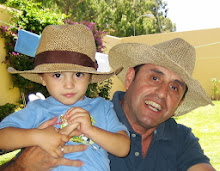
I had never seen Paris in the snow. It's freezing cold, but it's just as beautiful as ever. I'm having a wonderful time with my family -specially with my little grandson, Leo. From Paris a thought for my students in Spain. See you very soon.

Friday, 29 January 2010

International Day of Peace and Non-Violence


Spanish schools tend to celebrate the International Day for Peace on January 30th, the day of Mahatma Gandhi's death.
Many other countries and also the UN, celebrate this day on March 21st. The date is not so important as long as we take the opportunity to reflect about the meaning of peace and what we can do in order to achieve it.

Peace One Day has a website full of ideas and initiatives to bring peace to the world. It is worth paying a visit (watch video Peace one day in 60 seconds). Jeremy Gilley, founder and chairman of Peace One Day brought up the idea to fix in the calendar one day of ceasefire and peace. That day ended up being Sept 21st. In the following video he explains how he did it.


If you feel like reading a bit more about War and Peace in Art, here is an interesting article.

Tuesday, 26 January 2010

Colour idioms with The Teacher

"The Teacher" from the BBC is going to help us today to become familiar with some "colour idioms". Have a look at this video explaining some idioms connected with colour green:
  • To have green fingers
  • The grass is always greener on the other side
  • To be green with envy
And this one about colour gold:
  • As good as gold
  • A heart of gold
  • Worth its weight in gold
Have fun.

Sunday, 24 January 2010

Tired or tiring? Crossword


There is an important group of pairs of adjectives in English ending in -ed or -ing. Their correct use is confusing for many students. In this crossword you can practise some of them. Good luck!

Wednesday, 20 January 2010

Haiti devastated by massive earthquake


Last January 12th the Caribbean country of Haiti was struck by a 7.0 magnitude earthquake. This is how the BBC reported this terrible event the following day.

A week later the government has reported more than 100,000 deaths, and thousands of people are still missing. Relief teams and aid are arriving from all over the world but there are terrible problems of organization and infrastructure to reach the victims.
The CNN is covering the disaster in full detail.
We want to express our solidarity with the people and the nation of Haiti.

Wednesday, 13 January 2010

And tomorrow... THEATRE


Our class is going to the theatre tomorrow. We're going to watch "Pygmalion" a classical play by George Bernard Shaw. If you want to find out a bit more about the company which is going to perform, click here. I hope we all enjoy the show and have a good time. See you there!
If you wish to have a look at the script of the play, here it is.

Saturday, 2 January 2010

Clauses of Cause and Reason


Some days ago we talked about "purpose clauses" (they answer the question "what for?") and today we want to talk about "clauses of cause and reason" (they answer the question "why?").

If we look carefully we will realize that they are two different concepts. Broadly speaking we could say that the "purpose" looks ahead and generally has to do with ourselves, with our personal intentions or objectives, while the "reason" usually looks back and often has to do with other people's impositions upon us. Some people mix them and when you ask "why?" they answer... "in order to..." or when you ask "what for?" they come up with "because..."

The Beatles have an appropriate song to illustrate this question: "Tell me why" (lyrics)


And of course they also have a song to illustrate the answer: "Because" (lyrics)


Thursday, 31 December 2009

Happy New Year 2010


A New Year is knocking at the door. Let's let it in. Every new year comes full of blessings if we only open our hearts to appreciate them. 
Singing the Auld Lang Syne at the stroke of midnight has become a tradition in English-speaking countries and others. If you want to learn more about this tradition, read here.


Hogmanay is the name given to the celebrations of the New Year in Scotland. It is a very exciting celebration especially in Edinburgh. Read more about it. 

Tuesday, 29 December 2009

Adjective Word Order

Have you ever wondered why we say "a tall basketball player" and not "a basketball tall player", or "an expensive gold watch" instead of "a gold expensive watch"?
The order of the adjectives is important in English and it is not an easy topic for Spanish students.
As a general rule we know that most adjectives are used in front of the noun (not after it as in Spanish), and we also know that the basic order of the adjectives is this: qualitative adjectives, colours and classifying adjectives.
If you want to learn a bit more let me tell you that when I was a boy I had a mnemonic sentence which helped me to remember the order of the adjectives: "Very Soon a Slow Old Train Should Come From My Province". Have a look at these notes I have prepared for you and you'll see what I mean.
When you are ready have a go at these exercises.

Friday, 25 December 2009

Merry Christmas


"Today in the town of David a Saviour has been born to you; he is Christ the Lord"  (Luke 2,11)

Still another rainy day. It just feels like being at home, warm and cosy, sharing dinner with the ones we love. After all that's what Christmas is about, isn't it?
On this special day I'd like to thank you all: my students and the people who have visited this blog in these two months, and have taken the trouble to leave their comments. Needless to say how much I'm enjoying sharing this blog with you all. My only intention is to help us all to improve our knowledge of this beautiful and interesting language that English is. 
I hope you keep visiting it in the future and sharing your opinions and comments with all of us. Thank you... and MERRY CHRISTMAS! 
Jess has just sent us this wonderful video she wants to share with all of us. Thanks, Jess! 


Wednesday, 16 December 2009

The Twelve Days of Christmas


Time to have a look at what people do these days in the British Isles. Read a bit and see if you can spot any significant differences with Christmas celebration in Spain?
If you think you know EVERYTHING about Christmas, you're wrong. If not try this Christmas Quiz.
One of the most popular Christmas song of all times is "The Twelve Days of Christmas" but do you know what days they refer to?


Sunday, 13 December 2009

Modals ...and IV: shall, will and would


We finish our brief study of modals today with shall, will and would. Although there are many functions and notions expressed with these three modals, they are best known by the following ones:
  • Will is traditionally associated with the future and also with making requests.
  • Shall, usually associated with making suggestions and offers of help, has several other uses, most of them considered old fashioned or too formal.
  • Would is the reference par excellence for conditionals and also the equivalent of will in the past and reported speech.
You probably want to practise a bit now. Visit this web.

Wednesday, 9 December 2009

Human Rights Day


Dec 10th is probably one of the most remarkable dates for human kind. On Dec 10th, 1948, the General Assembly of the United Nations adopted and proclaimed the Universal Declaration of Human Rights at the Palais de Chaillot in Paris.
According to the Guinness Book of Records, the UDHR is the "most translated document" in the world. If you have not read the Declaration yet, maybe today is the day. Have a go and you will be impressed. Decide which article is in your opinion the most important one.
Watch this video produced by the Human Rights Action Centre.